


Share


Follow Us
Platelet Count
Thrombocytosis is seen in many inflammatory disorders and myeloproliferative states, as well as in acute or chronic blood loss, hemolytic anemias, carcinomatosis, status post-splenectomy, post- exercise, etc.
Thrombocytopenia is divided pathophysiologically into production defects and consumption defects based on examination of the bone marrow aspirate or biopsy for the presence of megakaryocytes. Production defects are seen in Wiskott-Aldritch syndrome, May-Hegglin anomaly, Bernard-Soulier syndrome, Chediak-Higashi anomaly, Fanconi’s syndrome, aplastic anemia (see list of drugs, above), marrow replacement, megaloblastic and severe iron deficiency anemias, uremia, etc. Consumption defects are seen in autoimmune thrombocytopenias (including ITP and systemic lupus), DIC, TTP, congenital hemangiomas, hypersplenism, following massive hemorrhage, and in many severe infections.
About Platelets
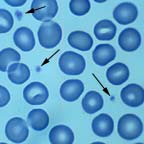 The main thing to remember about platelets is to look for them first! A typical tyro maneuver is to study a blood smear for an hour looking for some profound hematological abnormality, never to realize there is nary a platelet in sight. It is therefore necessary to discipline yourself to first check for a normal number of platelets when sitting down with a slide, before being seduced by the midnight beauty of the basophil’s alluring granules or the monocyte’s monolithic sovereignty. The normal platelet count is 133 – 333 x 103/µL.
Platelets are counted by machine in most hospital labs and by direct phase microscopy in smaller facilities. Since platelets are easily mistaken for garbage (and vice versa) by both techniques, the platelet count is probably the most inaccurate of all the routinely measured hematologic parameters. Actually, you can estimate the platelet count fairly accurately (up to an absolute value of about 500 x 103/µL) by multiplying the average number of platelets per oil immersion field by a factor of 20,000. For instance, an average of ten platelets per oil immersion field (derived from the counting of ten fields) would translate to 200,000/µL (10 x 20,000). Abnormal bleeding generally does not occur unless the platelet count is less than 30,000/µL, if the platelets are functioning properly. Screening for proper platelet function is accomplished by use of the bleeding time test.